
Proving Liability in an Auto Accident
Proving Liability in an Auto Accident
Learn how liability is determined after a car accident, including how fault is established, what evidence matters most, and how insurance companies and courts evaluate responsibility.
Quick Answer: To prove liability in a car accident, you must show that another party owed a duty of care, breached that duty through negligence or misconduct, and caused damages as a result—using evidence such as police reports, witness statements, photos, and expert analysis.
Liability in a car accident refers to legal responsibility for causing the crash. In most cases, liability is based on negligence — meaning one or more drivers failed to act with reasonable care under the circumstances. Insurance companies, and sometimes courts, evaluate what happened before, during, and after the accident to determine who is legally at fault and how damages should be handled.
Understanding how liability is proven can help you protect your rights, preserve critical evidence, and avoid mistakes that could weaken your claim. This guide explains how fault is evaluated in car accident cases and what factors matter most.
Car accident liability falls under car accident law, a subset of motor vehicle accident law that governs crashes involving passenger vehicles and related injury claims.
How Liability Is Determined in a Car Accident
To establish liability, most car accident claims rely on negligence, which generally requires proving four elements:
1. Duty of Care
Every driver has a legal duty to operate their vehicle in a reasonably safe manner and to follow traffic laws. This includes obeying speed limits, paying attention to the road, yielding the right of way when required, and adjusting driving behavior for weather or traffic conditions.
Because driving inherently involves risk, the law assumes all drivers owe this duty to others on the road.
2. Breach of Duty
A breach of duty occurs when a driver fails to act as a reasonably careful person would under similar circumstances. In car accident cases, this often involves clear violations of traffic laws or unsafe driving behavior, such as:
- Speeding or driving too fast for conditions
- Running a red light or stop sign
- Driving while distracted, fatigued, or impaired
- Following another vehicle too closely
Even a momentary lapse in judgment, such as checking a phone or misjudging a turn, can be enough to establish a breach if it leads to a collision.
3. Causation
Proving a breach of duty is not enough on its own. You must also show that the driver’s actions directly caused the accident and the resulting injuries or damage. This means demonstrating a clear connection between what the driver did wrong and what happened next.
For example, if a driver runs a red light and strikes another vehicle, causation is usually straightforward. In more complex situations, such as chain-reaction crashes or accidents involving road hazards, determining causation may require additional evidence or expert analysis.
4. Damages
Damages refer to the losses suffered as a result of the accident. To succeed in a liability claim, these losses must be measurable and supported by evidence. Common types of damages include:
- Medical expenses related to accident injuries
- Property damage to vehicles or personal belongings
- Lost wages or reduced earning capacity
- Pain and suffering or emotional distress
Without provable damages, liability alone is not enough to support a car accident claim, even if another driver was clearly at fault.
Evidence Commonly Used to Prove Liability
Strong evidence is critical in liability disputes, especially when fault is contested. Insurance companies rely heavily on documentation created close in time to the accident. Common forms of evidence include:
- Police accident reports
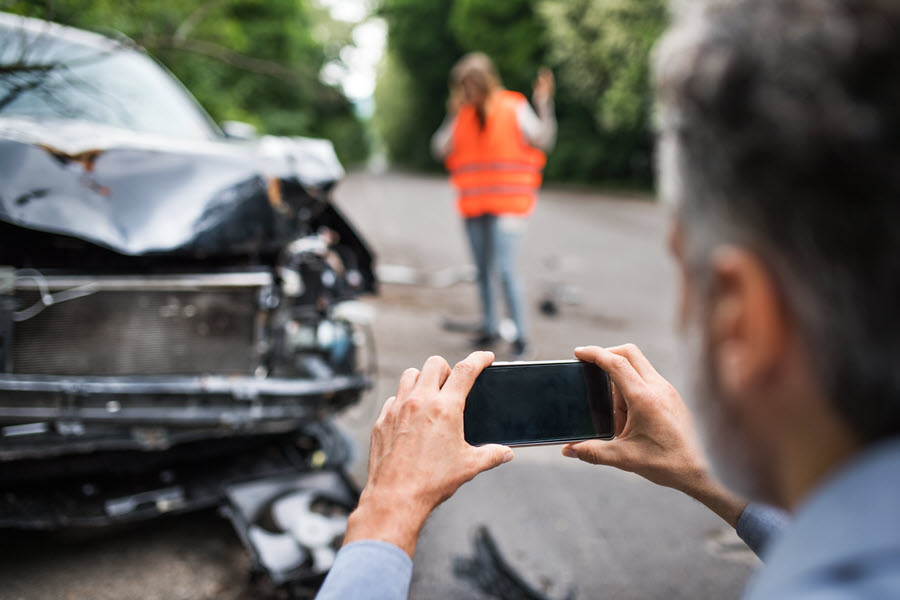
- Photos or videos of the scene, vehicles, and road conditions
- Witness statements
- Traffic camera or dashcam footage
- Vehicle damage patterns
- Medical records linking injuries to the crash
- Cell phone records (in distracted driving cases)
In more complex cases, accident reconstruction experts may be used to analyze speed, impact angles, and stopping distances to clarify how the collision occurred.
Comparative vs. Contributory Negligence
Fault rules vary by state and can significantly affect how much compensation an injured person can recover.
Comparative Negligence
In states that follow comparative negligence rules, an injured person may still recover compensation even if they were partially at fault for the accident. However, their recovery is typically reduced by their percentage of responsibility. For example, if you are found 20% at fault, your compensation may be reduced by 20%.
Contributory Negligence
In a small number of states, contributory negligence rules apply. Under these laws, any fault on the injured person’s part (even a small amount) can bar recovery entirely. Because of this, liability disputes in contributory negligence states are often more aggressively contested.
Multiple Parties and Shared Liability
Liability is not always limited to a single driver. In some cases, responsibility may be shared among multiple parties, including:
- Multiple drivers in chain-reaction or multi-vehicle collisions
- Employers, if a driver was working at the time of the accident
- Vehicle manufacturers, if a defect contributed to the crash
- Government entities, in cases involving unsafe road design or poor maintenance
Identifying all potentially liable parties can be critical to recovering full compensation, particularly in serious or high-damage accidents.
What Can Complicate Liability Determinations
Liability disputes are more likely when the facts of an accident are unclear or contested. Common complicating factors include:
- Conflicting witness statements
- The absence of a police report
- Accidents involving uninsured or underinsured drivers
- Poor weather or road conditions
- Injuries that appear days or weeks after the crash
These factors can delay claims, increase insurance disputes, and make thorough documentation especially important.
What Not to Do When Liability Is in Question
When fault is disputed, certain actions can unintentionally weaken your claim:
- Don’t admit fault at the scene
- Don’t speculate about what caused the crash
- Don’t rely solely on the other driver’s insurer
- Don’t delay medical treatment
- Don’t assume liability is obvious
Statements made early can later be used against you.
When to Talk to a Lawyer About Liability
Proving liability in a car accident requires more than showing that a crash occurred—it requires evidence, legal standards, and a clear connection between negligence and damages. Acting quickly, documenting the scene, and understanding how fault is evaluated can significantly affect the outcome of a claim.
To learn more about how liability fits into the broader claims process, explore our Car Accidents guide.
Conclusion
Being involved in a car accident can be unsettling, but taking the right steps immediately afterward can help protect your health, your legal rights, and your financial interests. Staying calm, documenting the scene, and following proper procedures can significantly reduce complications later.
To learn more about how car accident claims work including liability rules, insurance coverage, and compensation, visit our Car Accidents guide.